
Our client:
Guenthers is a well-established food manufacturing facility. The company produces a wide range of products that rely on consistent, high-quality flour brewing systems. Operating in a fast-paced industry, reliability and productivity are essential. They require modern, efficient technology ensuring operations run smoothly and avoid costly downtime.
The Challenge: An Aging System impacting reliability and productivity

Operating since the early 1990s, the existing flour brew system was becoming increasingly difficult to maintain. Overall Equipment Effectiveness (OEE) – the efficiencies required – were no longer being delivered by their equipment.
Guenthers saw this as an opportunity to introduce a new bespoke system with state-of-the-art technologies. This upgrade would benefit not only their workforce but their customers as well. Working with Denca throughout the development stage, together we were able to develop a cost-effective solution to what was quickly becoming an expensive problem.
A particular challenge was the absence of updated system drawings. System control panels had been modified several times over the years without proper documentation. Additionally, most of the system’s parts had become obsolete. Replacements were hard, if not impossible to find, exacerbating the problems.
The customer’s objectives were clear:
- Reduced downtime
- Improved OEE
- A more efficient, reliable system
- Reduced waste
- Quicker line changes
These were the key goals for Denca as we aimed to achieve an innovative and thoughtful solution.


The Solution: A Comprehensive System Overhaul with Modern Technology

Denca took a comprehensive approach to the problem, starting with a full survey of the existing flour brew system.
We collaborated closely with operators, engineers, and managers to gain a deep understanding of how the system functioned and what specific challenges were being faced. Through these discussions, we identified key areas where modern technology could significantly enhance the system’s performance.
We proposed a comprehensive solution that included:
- Upgrading the Mitsubishi PLCs to Allen Bradley PLCs
- Installing Hardy load cells, which provided a huge improvement over the existing high- and low-level sensors
- Standardizing all control panels across the site to reduce the number of spare parts the customer needed to stock
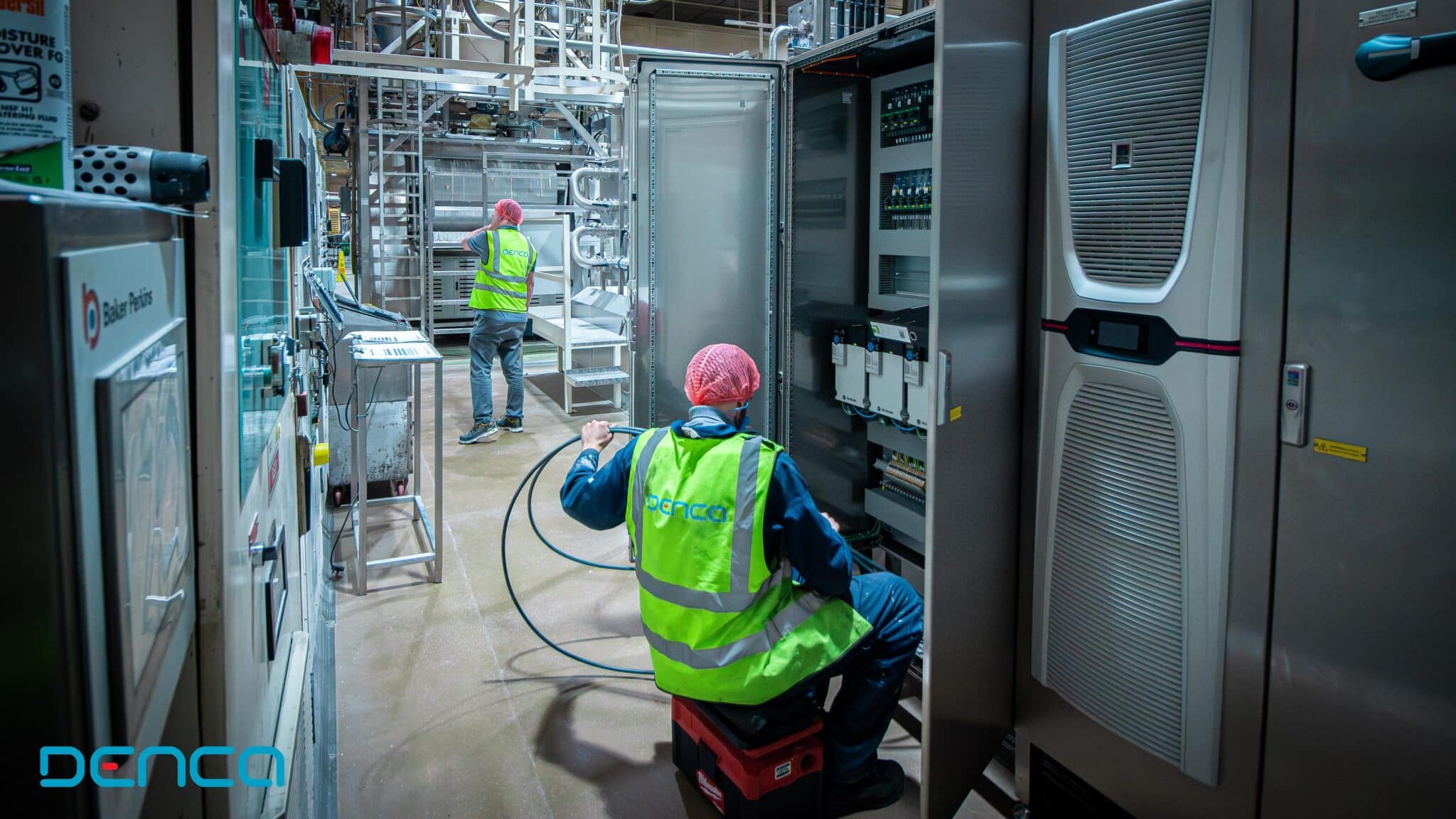
One of the key aspects of this project was our ability to propose a flexible installation plan. Originally, the client wanted us to remove the old control panel and install the new system during a single shutdown. However, we advised that this would be unrealistic given the timeframe. Instead, we suggested installing the new control panel in a different location, allowing for a smoother and less time-consuming transition from the old system to the new one.
Despite working in a congested area, we ensured that the flour brew system remained operational throughout the installation process, minimizing any disruption to the client’s production schedule.

The Outcome: Enhanced Reliability and Productivity, Efficiency and Operator Experience
The newly installed system delivered significant technological and business benefits:
- Power Monitoring and Energy Efficiency: The upgraded system included power monitoring and Variable Speed Drives (VSDs) on all 17 motors, allowing for more energy-efficient operation and better control over the entire process.
- Improved Load Cell Technology: With the Hardy load cells in place, the system now self-calibrates, greatly improving the accuracy and reliability of measurements.
- Enhanced Operator Experience: We installed a 22” touchscreen HMI (Human-Machine Interface) and a power monitoring meter, simplifying the operation for the facility’s operators.
- Measurable Business Benefits: The client now sees reduced downtime, a marked improvement in OEE, and a system that uses less energy while producing an improved final product.
Our collaborative approach, attention to detail, and effective communication were highly appreciated by the client. They specifically commended the design, the high standards of installation, and the fact that we completed the project ahead of schedule.
This project is a perfect example of how Denca approaches complex industrial automation challenges.
By upgrading an aging and unreliable system with modern technology, we solved the client’s immediate problems and provided long-term benefits in terms of efficiency, reliability, and operator ease of use. As a result, the food manufacturing facility is now better positioned to meet its production goals with reduced downtime and improved product quality.

From our customer:
“The system is exceptionally well designed and laid out, and the project was managed with the utmost professionalism. We are grateful to Denca for taking on the most critical part of the shutdown project, which carried the highest level of risk, and integrating it seamlessly into our operations. We are highly satisfied with the outcome and look forward to the next upgrade. Thank you from all of us here.” – Andrew, European Group Project Manager
Conclusion:
This project is a perfect example of how Denca approaches complex industrial automation challenges. By upgrading an aging, unreliable system with modern technology, we not only solved the client’s immediate problems but also provided long-term benefits in terms of efficiency, reliability, and operator ease-of-use. As a result, the food manufacturing facility is now better positioned to meet its production goals with reduced downtime and improved product quality.
 Before I/O Panel Installation
 I/O Panel Installed

 Planned space for Remote I/O
 Successful commissioning of Remote I/O